 Skip to content
 Whether you’re increasing production capacity, improving product quality, incorporating more recycled content, or reducing operating costs, consistent material preparation is essential to a high-performing plastics operation.
If you’re experiencing:
✓ Moisture-related defects
✓ Inconsistent material feeding
✓ Excessive scrap
✓ Manual material handling
✓ Difficulty processing recycled materials
✓ Production interruptions
your auxiliary equipment—not your primary machine—may be the limiting factor.
Leap Green Polymers helps manufacturers evaluate their production process and specify integrated auxiliary systems that improve quality, productivity, and operational efficiency.
In plastics processing, problems rarely start at the machine. They start upstream — in how materials are stored, dried, conveyed, and dosed before they reach the screw or mould.
Moisture in engineering resins causes bubbles, splay marks, and degradation. Inaccurate masterbatch dosing creates colour inconsistency and off-spec parts. A bottleneck in your conveying system starves your line and kills throughput. Contamination from improper material handling damages tooling and drives up reject rates.
Most Canadian processors have assembled auxiliary systems from multiple vendors over time. The result is often mismatched equipment, gaps in process control, and no clear path to improvement.
Leap Green Polymers helps Canadian plastics manufacturers specify, integrate, and implement auxiliary and material handling solutions that address the root causes of process variability—from material intake through machine-side delivery.
Working with MainTech, our Italian technology partner, we provide a complete range of equipment for drying, conveying, dosing, storage, and scrap recovery — available as individual units or fully integrated, Industry 4.0-ready centralized systems.
Every solution begins with your process: your materials, your machines, your layout, and your production targets. We specify, supply, and support — so you get a system that performs from day one.

Manufacturer Goal | What Better Auxiliary Equipment Delivers |
Reduce downtime | Consistent, automated material flow eliminates starvation and manual handling delays |
Improve part quality | Precisely dried and dosed material reduces defects, splay, and colour variation |
Lower scrap rates | Accurate dosing and proper drying reduce off-spec production at the source |
Increase productivity | Centralized systems keep multiple machines running simultaneously without operator intervention |
Reduce labour costs | Automated conveying and material selection reduce manual material handling tasks |
Process recycled content | Proper preparation systems enable higher recycled material content without quality compromise |
Support circular economy goals | Beside-machine granulators recover scrap immediately for reuse — closing the loop at your press |
Auxiliary and material handling equipment is not one-size-fits-all. The right system depends on your resin type, machine configuration, throughput requirements, and production environment. Here’s how we approach the most common challenges Canadian processors face.
Challenge: Moisture in hygroscopic resins — PET, PA, PC, PLA, ABS, and engineering polymers — causes splay marks, bubbles, degradation, and reduced molecular weight. Processing wet material can permanently damage the resin and compromise part integrity.
Solution: Leap Green Polymers specifies and supplies dehumidifying dryer systems matched to your resin type and throughput. Twin-tower desiccant systems provide continuous dry air at a constant dew point — critical for PET, engineering polymers, and recycled content applications. Hot air dryers handle non-hygroscopic materials. Both are paired with insulated stainless steel drying hoppers from 15 to 12,000 litres.
Benefit: Consistent material moisture content. Reduced defect rates. Better part quality. Ability to run higher recycled resin content without quality compromise.
Challenge: Inaccurate dosing of masterbatch, colourants, or additives leads to colour variation, inconsistent mechanical properties, and higher additive consumption. Manual dosing introduces human error and creates batch-to-batch variability.
Solution: We specify volumetric and gravimetric dosing units matched to your machine size, throughput, and material type. Solutions cover a wide range — from compact units for small injection machines to high-capacity gravimetric systems for large extrusion or compounding lines. Liquid dosing, powder dosing, and multi-component blending systems are all available.
Benefit: Precise, repeatable additive incorporation. Reduced masterbatch consumption. Consistent colour and properties. Documented batch data for quality records.
Challenge: Manual material handling is slow, error-prone, and labour-intensive. As plant volumes grow, moving material by hand creates bottlenecks, increases contamination risk, and ties up operators who should be focused on production quality.
Solution: Centralized conveying and feeding systems that automate material transport from silos or big-bag stations to multiple machines simultaneously. Systems include pneumatic loaders, automatic material selection manifolds, PLC controls, and full supervisory software — Industry 4.0 compatible. Designed to your plant layout, machine count, and material types.
Benefit: Continuous, automated material supply to multiple machines. Reduced labour requirements. Lower contamination risk. Full process traceability. Scalable as your operation grows.
Challenge: Sprues, runners, edge trim, and start-up scrap are generated every shift. If not recovered efficiently and cleanly, this material ends up in waste bins — a direct cost that compounds across your production volume.
Solution: Beside-machine granulators positioned directly at the press recover sprues and runners immediately after ejection, producing clean regrind for immediate reintroduction to the process. Models available for small and medium part sizes. Inclined cutting chamber designs allow fast material changeovers and easy cleaning between runs.
Benefit: Post-industrial scrap converted into immediately usable regrind. Reduced material waste and cost. Cleaner regrind quality. Closed loop at your press.
Challenge: Processing PET and PLA — especially from recycled streams — requires crystallization before drying. Without proper crystallization, these materials stick together in the drying hopper, causing bridging, inconsistent flow, and processing failures.
Solution: Leap Green Polymers supplies crystallizing systems specifically designed for PET and PLA flakes or granules. Integrated reel mixer and hot air drying system in a single unit prevent bridging and ensure uniform heat distribution before the material enters the dryer. Available from 300 to 6,000 litres.
Benefit: Reliable, consistent processing of PET and PLA — including recycled streams. Enables manufacturers to incorporate post-consumer PET and bio-based PLA without processing disruptions.
Challenge: Inefficient material storage leads to contamination, material mixing errors, and unnecessary manual handling. Big-bag unloading without dedicated systems creates dust, spillage, and ergonomic risk on the plant floor.
Solution: We supply stainless steel storage bins, modular indoor silos (40 litres to 60,000 litres), and flexible indoor silos for powder and granule storage. Dedicated big-bag unloading and loading stations with vacuum or pressure feeding and material level control. Available with accessories for level monitoring and automated refilling.
Benefit: Clean, organized material storage. Reduced contamination risk. Safer, more efficient big-bag handling. Improved plant housekeeping and compliance.
You could source auxiliary equipment through any number of channels. The reason Canadian manufacturers work with Leap Green Polymers is the combination of technical knowledge, application expertise, and local accountability that comes with every project.
Canadian Technical Support
We are based in Canada and serve manufacturers across Ontario, Quebec, and nationally. You are not calling an offshore support line. You are working with a local technical partner who understands Canadian manufacturing conditions, regulatory context, and supply chain realities.
Application-First Specification
We do not sell from a catalogue. Every recommendation begins with your process: your resin types, your machines, your throughput, and your goals. We specify the system that solves your problem — not the one that is easiest to sell.
Circular Economy Expertise
Leap Green Polymers exists to help the plastics industry make the transition to a circular economy. Our auxiliary equipment recommendations are informed by this mission — helping you process more recycled content, recover more scrap, and prepare for the next stage of sustainable manufacturing.
European Technology. Local Accountability.
Our technology partner, MainTech S.r.l. (Italy), has been designing and manufacturing auxiliary equipment for plastics processors for over four decades. Their systems operate in plants across Europe, the Americas, and Asia. MainTech America Inc. (Dalton, Georgia) provides North American technical support. You benefit from global engineering expertise with local project management from Leap Green Polymers.
Integrated Solutions, Not Isolated Equipment
Auxiliary equipment does not operate in isolation. At Leap Green Polymers, we look at your entire process — from raw material intake to finished part — and recommend systems that work together. If you also need recycling equipment, compostable polymer supply, or circular process consulting, we can support that too.
Our material handling and auxiliary equipment solutions are specified for the following plastics processing applications:
Tell us about your operation — your resins, your machines, your current challenges — and we will recommend the right solution for your process and your goals.

Ensure contaminant-free plastic processing by removing impurities and maintaining consistent material quality during production.
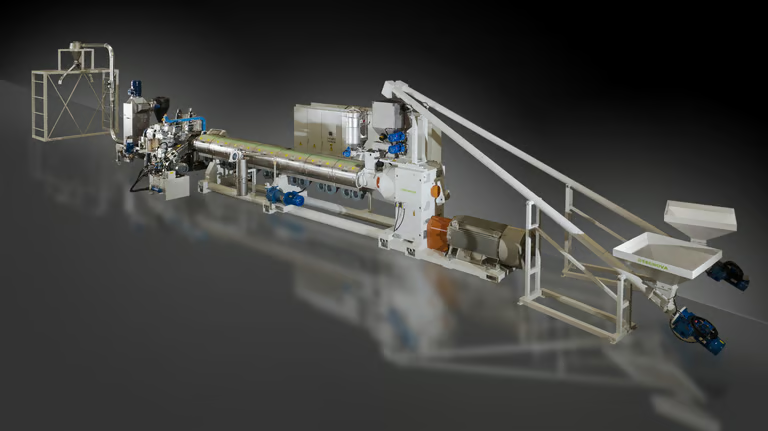
Integrated recycling systems designed for processing PCR (Post-Consumer Recyclate) and PIR (Post-Industrial Recyclate) materials efficiently.
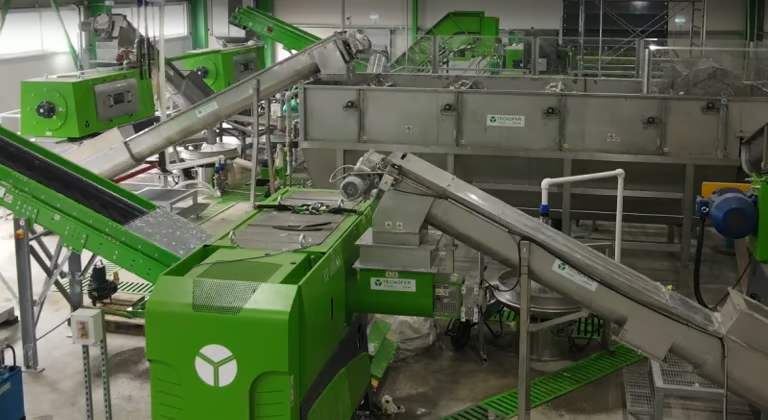
High-performance systems that clean and dry recycled plastics to maintain high material quality and preparation for further processing.
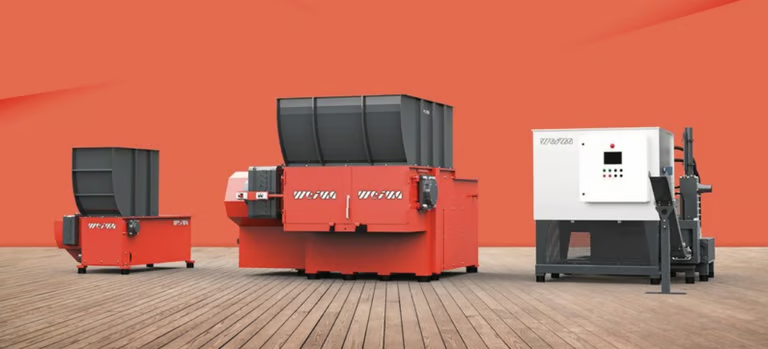
Precision size-reduction machinery that cuts and shreds plastic materials for easier handling and efficient recycling workflows.
Special for size reducing to compact and prepare plastic materials for extrusion and further processing, improving handling and production efficiency.
Including loaders, dosing units, drying and crystallization systems, mixers, storage containers, granulators, dedusting units, mold temperature controllers, and conveying solutions
Advanced detection systems that protect machinery and production lines from metal contamination and foreign materials.
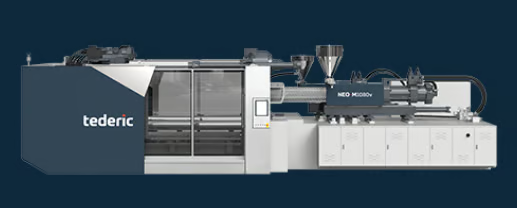
Energy-efficient injection molding systems designed for high-precision plastic manufacturing and reduced operational costs.
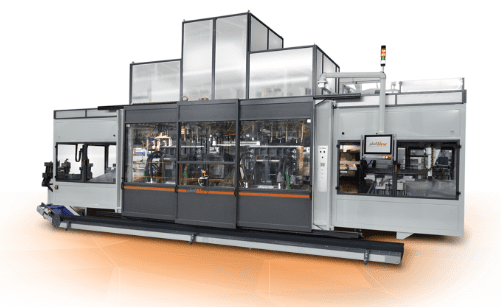
Advanced extrusion blow-molding technology enabling eco-conscious production with improved energy efficiency and performance.
 Optimized by Seraphinite Accelerator